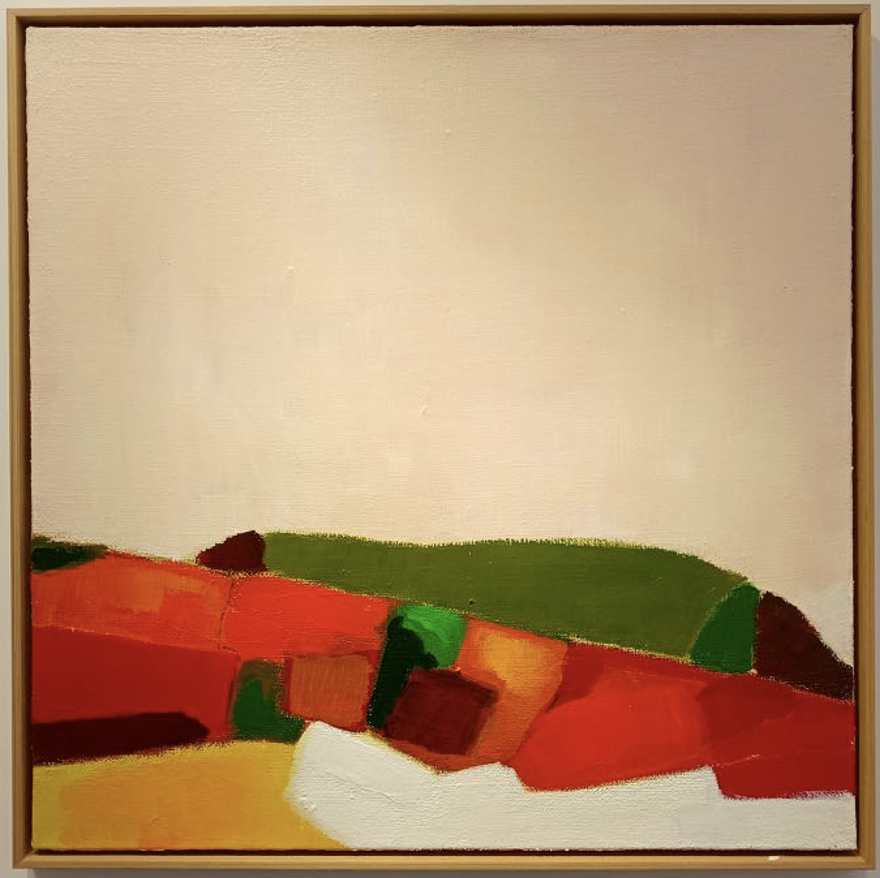
The exhibition, Mazen Rifai: Amorous Colors, presented a collection of twenty-five untitled paintings and thirteen tapestries in the Agial Gallery, Beirut. Although largely abstract, some of the paintings reveal themselves to be landscapes, with a skyline and a shape and depth to valleys and mountains (fig. 1). The paintings are confident and accomplished in execution, and their satisfying layering, rich and variegated shades, invites and rewards close inspection. However, it is the tapestries and their relationship to the canvas paintings that caught my attention and to which we will return.
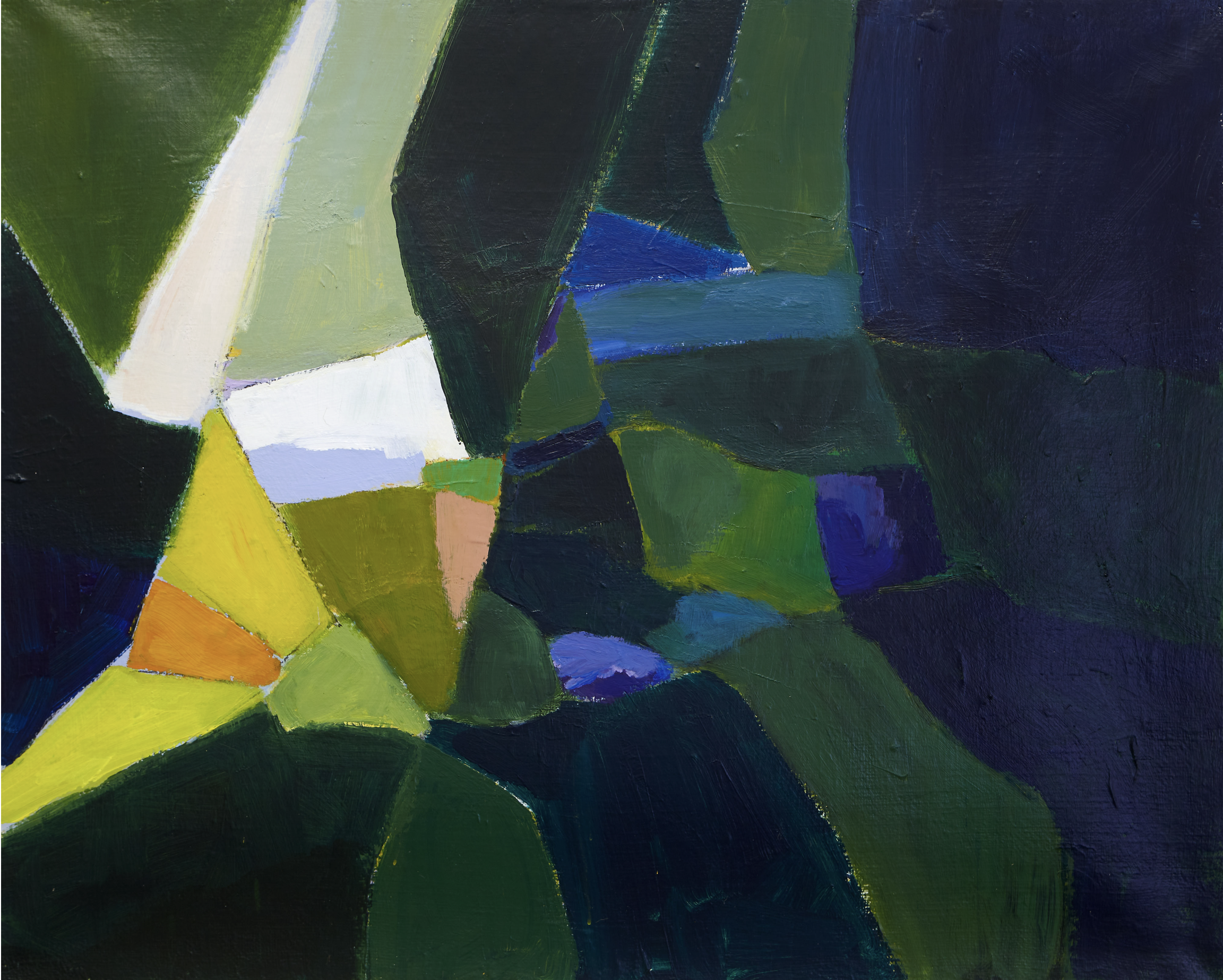
The paintings feature irregular blocks of colours, mostly primary, but there are multiple shades in the blocks. The blocks are painted on an under-layer that occasionally shows through outlining parts of the upper layer. There are blurred but roughly straight edges that are irregularly geometrical. They fit around one another like puzzle pieces filling the canvas. Indeed, they have a quality of a cross-section of earthy particles settled together, as if they aren’t merely images of the landscape they are close-ups of the material itself. In most cases this suggests the dust and grit of soil, and in others it resembles a cross-section of the cellular structures of leaves (fig. 2). These paintings have a certain affinity for the sort of thing one might see through an out-of-focus microscope. Simultaneously, they remind me of the view seen through a kaleidoscope, they are refracted and blurred, and don’t reveal the object at which the kaleidoscope is pointed. Thus, the paintings seem to encapsulate a large and small view of the land, but in both cases the view is distorted and what we are looking at is flattened, has lost its details, and thus seems to reference the experience of looking as much as it references the thing that is looked at.
The tapestries (fig. 3) don’t have this same quality. The images on the tapestries, are different because they are woven as a constituent part of the material objects, rather than being painted on top in multiple layers. Similarly, they don’t have blurred edged, they are much flatter and more fixed. Despite the use of different colours and textures of threads, the blocks seem solid and cohesive, with hard edge-like cracks. Indeed, the layering of the threads in lines of weft seems akin to the slow accumulation of geological layers in the land. Although the harder edges to the composition suggest a flatness in the image, the tapestry itself is not flat. The use of different qualities of thread introduces a buckling of the surface and thus the tapestries gently roll in valleys and hills like the landscapes that they represent. The sculpture-like quality of their three-dimensionality and the way that the image is part of the object itself gives a grounded materiality and tactility to the tapestries. The tapestries foreground the materials from which the image is made, materials that ultimately come from the land and seem closer to it because of the “artisanal” tradition in which tapestry is often located. While the paintings seem to represent the shifting experience of vision, the tapestries have a fixed “thingness” about them. Thus, the exhibition refers to multiple versions of the same land: distance and detail, experience and materiality. The canvas is the visual technology that brings the image to the viewer in the same way that the microscope and the kaleidoscope bring the image to the viewer. The tapestries however, don’t “bring-into-view”, they represent their landscapes as a synecdoche, as a piece of the land itself.
The text of the booklet of the exhibition tells us that Mazen Rifai comes from the Bekaa and this is the landscape from which he finds inspiration. According to the exhibition attendant, Rifai commissioned the thirteen tapestries from artisans living in his community in the Bekaa. The tapestries clearly attempt to emulate the blocky and colourful compositions of the painting, and all the works share the same dimensions (approximately). It seems that we are supposed to see a continuity between them, and Mazen Rafai is presented as the author of both sets of artworks. The omission of the names of the artisans with whom Rifai collaborated, and the presentation of Rifai’s unshared authorship is a questionable choice. Indeed, the modernist painter that seeks inspiration from, but simultaneously effaces, a “primitive” craft (often colonial or rural and coded feminine) is a cliche of nineteenth- and early twentieth-century art.
Nevertheless, the exhibition was the occasion for this writer to reconsider the role and nature of the media of these artworks.
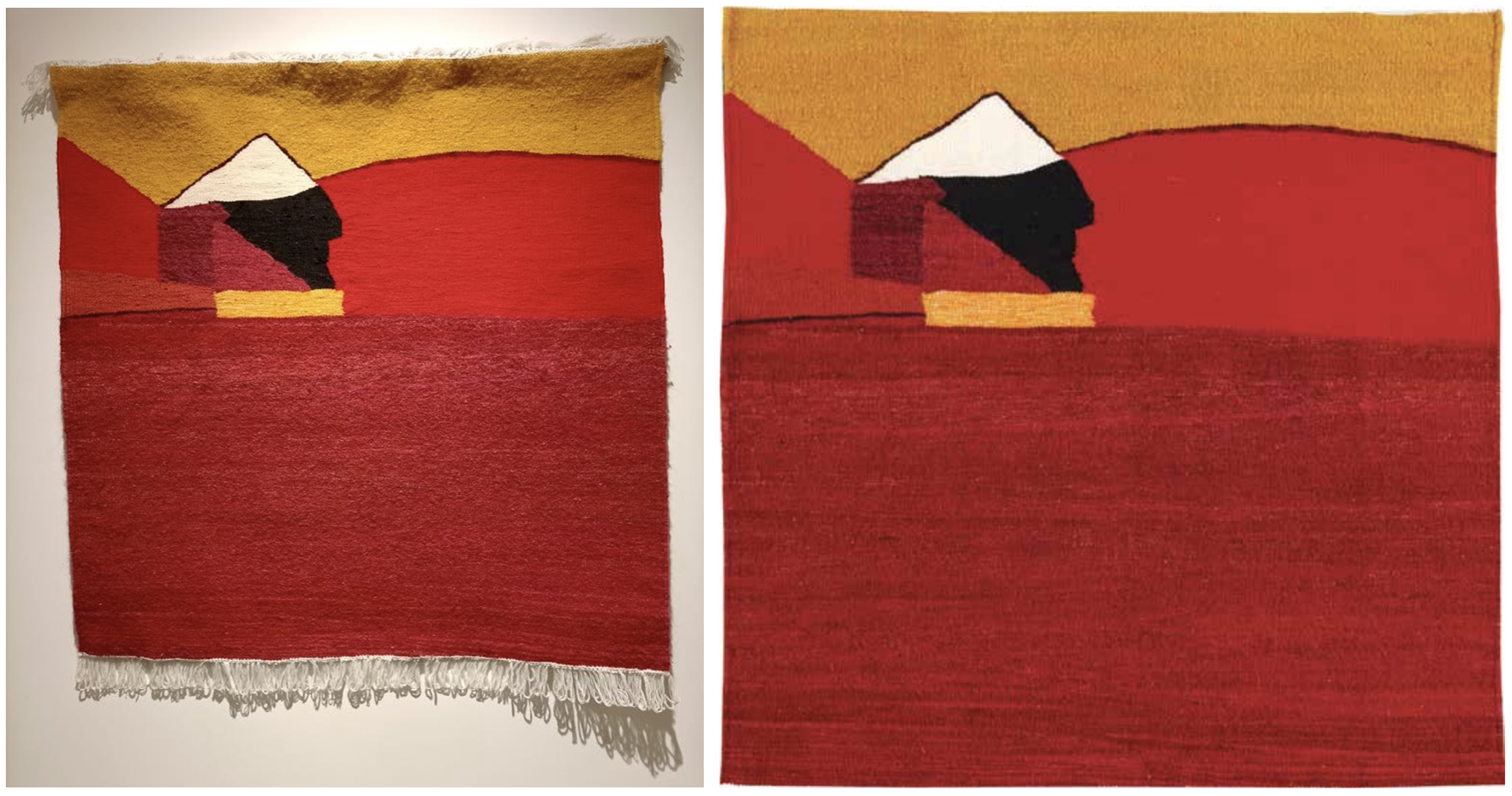
The challenge of the tapestry's "thing-ness" is particularly evident in the photography. Left: Author's photograph of the work in the gallery
Right: The work as photographed for the exhibition catalogue.
Tapestries, of course, are an extremely ancient artform that pre-dates the modernist canvas painting by thousands of years, yet is, for the most part associated with “craft” rather than “art”. Historically, the tradition of understanding artistic creation as dependent upon a genius designer gives priority to drawing and painting. In this tradition, the concept, the idea, the composition or the image (regardless of any one particular example) is primary. The images are tableaux, in the seventeenth-century sense of the word, they are merely windows onto the pensée de l’auteur.1 In that academic tradition, the artworks were not concerned with their materiality, they were successful as art based on their composition, on iconography, or their representation of appropriate moral stories, and the medium was largely irrelevant.
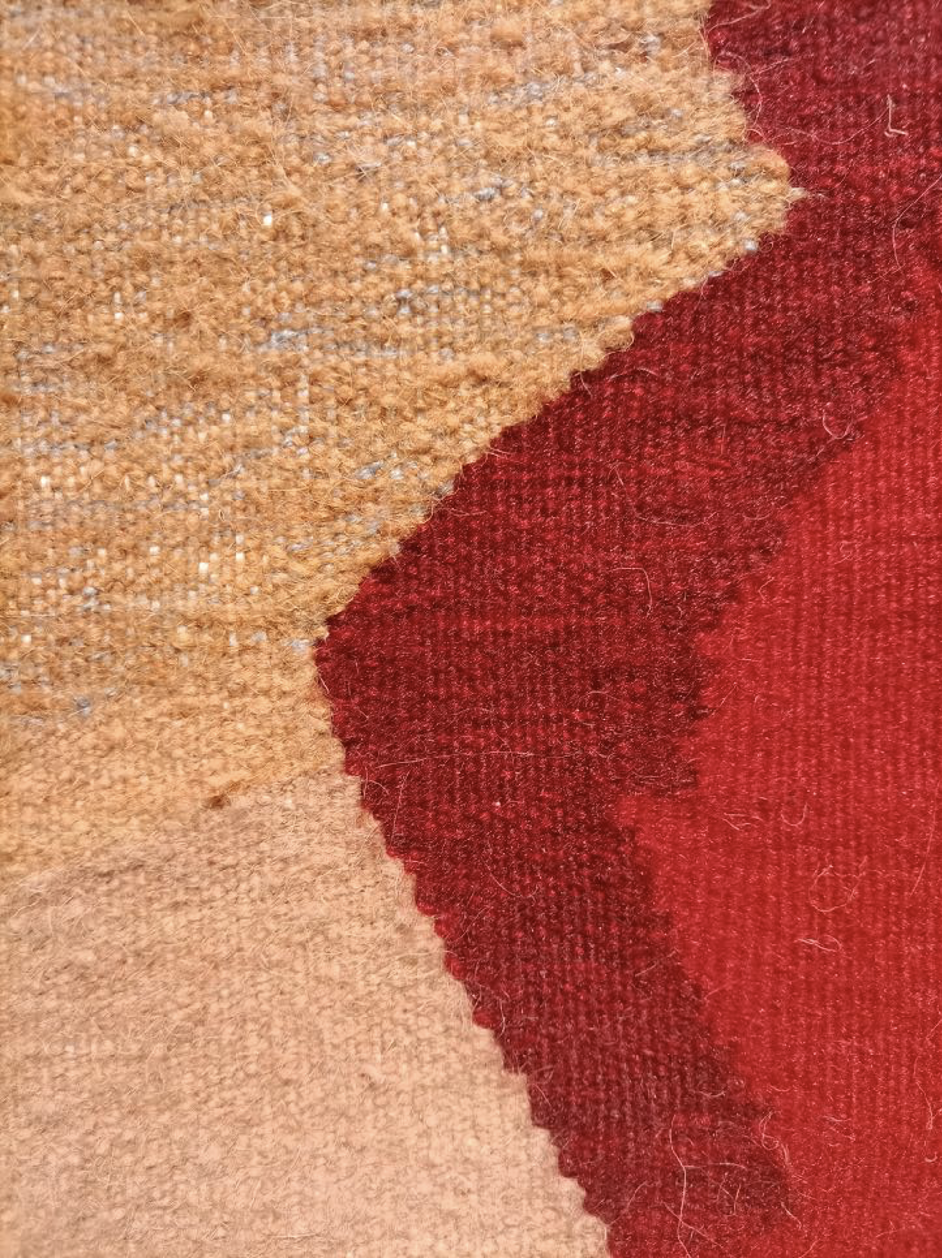
The translation of the imagery between the canvas paintings and the tapestries in the Amorous Colors exhibition is reminiscent of this tradition in which image is independent of medium. Tapestries can include figurative images, and the most famous ones do. However, tapestries are more than merely a reasonably flat surface on which the image might appear, the images that they bear are literally part of the material structure of the artwork (fig. 4). As an artform they are less prone to the sense that the image can be independent from the medium. It is only their reproduction in other artworks (e.g. prints or photography) that allows for any sense that they carry an image separate from their material structure. They are an object-image complex that existed long before the seventeenth-century discovered the tableau. Meanwhile, the role of canvas in the traditional canvas painting is to be covered up, yet it remains the hidden foundation.
Tapestry and canvas are both made on a loom and are then cut off it. Tapestries are a dense matrix of warp and weft. The width of tapestry is defined by the width of the loom and fixed by the selvedge edge, and although the length is undetermined (since one could keep adding more weft endlessly) once it is cut from the loom, it is prone to unraveling and has to be tied off. Once cut from the loom, canvas too is prone to loose threads and unravel unless its loose ends are tied, in which case it essentially becomes an unadorned or imageless tapestry. Alternatively, canvas can be fixed (usually by staples or pins) to something else; often it is fixed to a stretcher to become a support for a painting. Thus, canvas, long the foundational underpinning of the western painting tradition, is inherently unstable unless it returns to its origin on its loom-like stretcher.
In this way, the canvas painting has an edge and limits that are historically and materially conditioned and even inevitable. Every canvas painting, carries within it the form of its historical and material production. More than that, the historicity of textiles as a central product of the industrial revolution is impossible to overlook. The loom is not merely an artists’ tool, in modernity and today, it is part of the machinery of industrial capitalism.
Canvas painting came under increasing scrutiny in modernity.2 Subsequently, Jacques Derrida wrote about how the peripheral (the parergon), the outer-edge of the artwork or the limits of what counts as the artwork (the marginal imagery, the frame, the building in which it is installed, the visual tradition, historical and critical contexts) shapes and defines the artwork (the ergon).3 Although not the core subject or central image, the parergon is indispensable, without it, “the lack within the work would appear […] and this lack makes for the very unity of the ergon.”4 In Derrida’s definition, the core of the artwork is defined by an important lack. The ensuing debate often focused on the critical tradition that precedes and intellectually frames or shapes the work, but it also focused on the edges and visible frame that surrounded the painting, in part because Derrida cited it prominently.
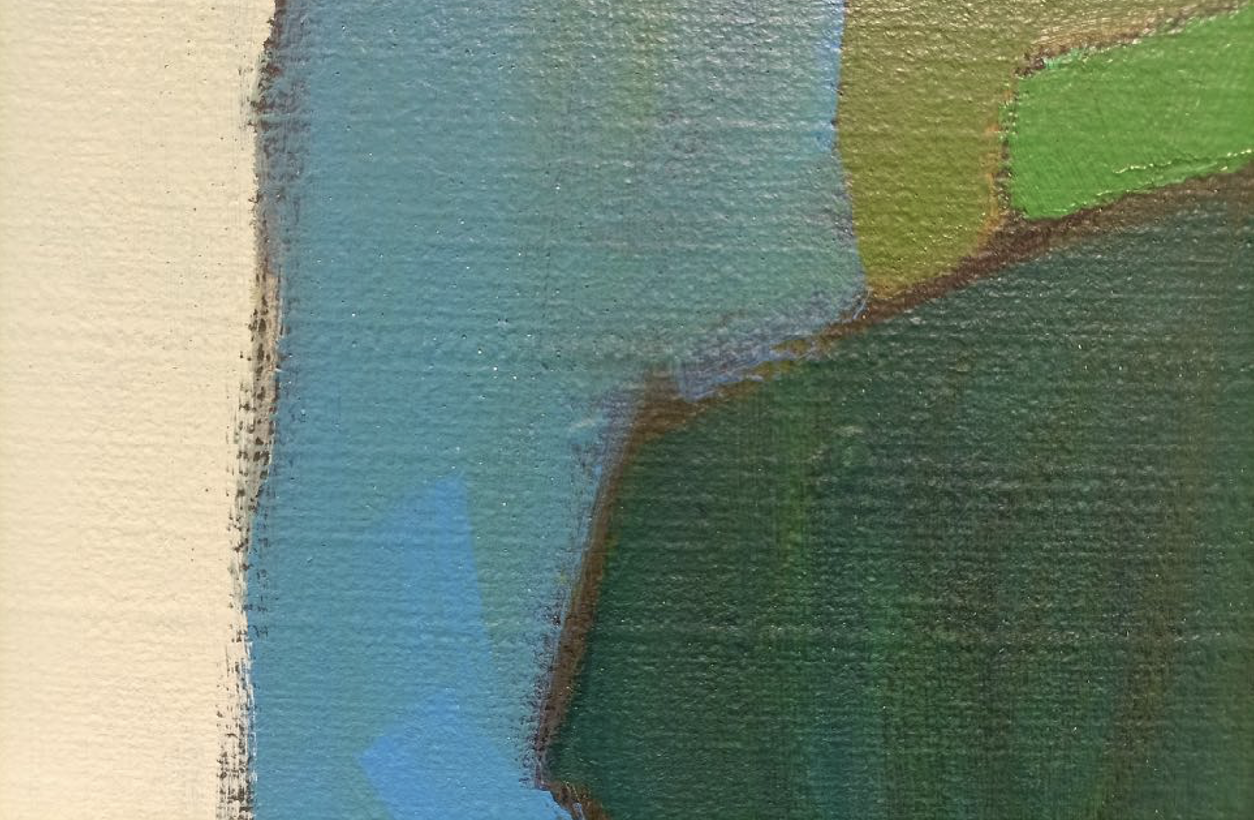
The slubbed threads (fig. 5) that run through the canvases used by Mazen Rifai for his paintings make the materiality of the canvas obvious. They are clearly paintings made on textiles pinned to a loom-like stretcher at the same time that the exhibition sets up a comparison between them and the tapestries that are cut from a loom. The tapestries have been liberated from the process of their production (the loom) and the canvas has been applied back to it in the creation of the flat surface — a canvas pinned over the loom-like stretcher. The conventional canvas painting always has a concealed interior frame (the loom-like stretcher), whether or not there is a visible exterior frame. It is as if the canvas of the painting is returning to the format of its material production, and an earlier historical state. Canvas paintings cover, but still include that earlier state. The loom-like stretcher precedes any exterior frame and predetermines the boundaries of the image long before an exterior frame is added. What I’m suggesting here, is that there is another rarely considered frame. Rather than the literal edge of the canvas, and rather than the visible outer frame, the ghost of a loom exists before and behind the painting, and it has a largely unacknowledged role in producing and shaping the image.
By expressing the canvas through the thick paint, and by drawing the comparison between the canvas painting and the tapestries, the exhibition and its artworks (intentionally or not) seems to allude to the canvas as support and the image as tableau. The contrast highlights that the canvas is the bearer of images and without an image they look unfinished, an unpainted canvas is waiting to be painted — it has a lack. This is the lack that defines the Derridian ergon, and thus this positions the canvas as the ergon and the tableau (the image) as the peripheral parergon. In this sense the traditional hierarchy of the arts, painting (high) and tapestry (low) is flipped, the painted image is merely a decorative embellishment on the canvas. The textile is the artwork and the painting merely justifies the presence of the textile. Arguably the image is the pareregonal ornament, it is additional to the material object—the textile. The image as parergon calls into being the material object, it brings these parts together. It is more than the edge or the frame, it is also the divorce between the materiality of the supporting medium and the imagery that is the insurmountable lack that defines the modernist parergon and the ergon.
Exhibition Details
Mazen Rifai: Amorous Colors
16 - 22 March 2025, Agial Gallery, Beirut